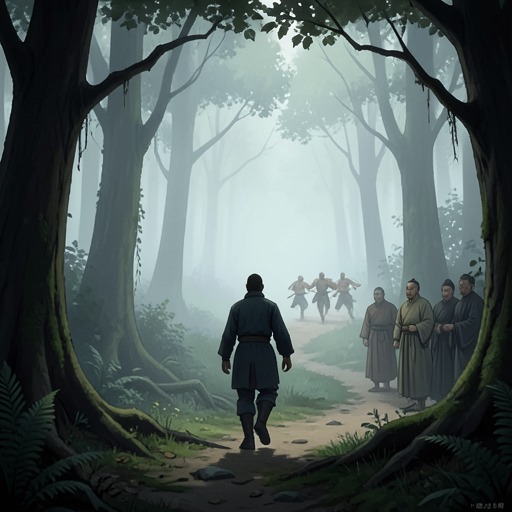
Bao BuTong
Demi-Gods and Semi-DevilsBao BuTong is a retainer of Murong Fu and one of the four followers who identify themselves to Xu Zhu at a tense encounter. His defining habit is to contest what others say, often by bending a word or argument until ordinary courtesy becomes comic disputation. Yet beneath the verbal combat, the episodes at Xue MuHua’s refuge show a loyal companion: even seriously weakened by frost poison, Bao insists that he and his companions should face danger rather than be left behind, and he yields when Deng BaiChuan intervenes.
Identity and Introduction
Bao BuTong is introduced alongside Deng BaiChuan, GongYe Gan, and Feng BoE as one of Murong Fu’s followers. When Xu Zhu attempts to address the men respectfully, Bao interrupts to correct the forms of address. Calling GongYe Gan “Benefactor Gong,” he argues, is wrong because the man’s surname is GongYe; calling Bao himself a benefactor is also wrong, he says, because he has never given alms to monks or nuns. The exchange continues as Bao reframes Feng BoE’s proposed fight as a kind of instruction that would benefit Xu Zhu. His objections make introductions themselves into a contest, displaying both quick verbal invention and a refusal to let conversation proceed on another person’s terms.
The pattern is not merely a catchphrase. In several scenes Bao begins his rebuttal with “Not true, not true,” then treats the other speaker’s phrasing as material to be challenged. His language makes him disruptive, but also gives him a recognizable comic presence amid negotiations and danger. When Xu Zhu explains that a monk should focus on cultivating the inner self rather than martial skill, Bao’s argumentative role has already been established as an obstacle to smooth exchange.
Wit and Verbal Combat
At Xue MuHua’s refuge, Bao applies the same habit to a dispute about a poisoned coffin. A bookish man denies that poison has been placed in a coffin, and Bao counters that there is no corpse inside: the poison is meant for the living people who might approach it. When the bookish man rejects this accusation, Bao turns to a saying attributed to Confucius about women and petty people being difficult, applying it to both the scholar and a woman present. The scholar is left unable to answer directly and dismisses Bao’s contribution as irrelevant. In this exchange, Bao’s wit does not settle the question of the trap; instead, it draws one opponent into an argument while XuanTong can intensify his attack on another.
Bao’s wordplay can be provocative even when the subject is practical. XuanNan proposes taking the frost-poisoned men to the physician Xue MuHua, but Bao observes that the physician is not afraid of Murong Fu’s Returning you with your own move. He jokes that if the physician were dying, he would need only to seek Murong Fu for rescue. The line draws laughter from the group, momentarily relieving the strain of their journey and illness without changing the need to find treatment.
When the Eight Friends of Hangu discuss their danger from Ding Chunqiu, Bao challenges the idea that they are doomed. He argues that Ding’s skill may not surpass XuanNan’s and that their combined shouting and effort might be enough to resist him. Frost poison interrupts his argument: his teeth begin to chatter, and he cannot finish what he is saying. Li KuiLei answers with a joke about Jing Ke, the attempted assassin of Qin Shi Huang, who caught a cold and could no longer speak. The scene places Bao’s comic confidence beside the physical limits imposed by his condition.
Frost Poison and the Journey for Treatment
The poison repeatedly constrains Bao’s actions. At the pavilion, XuanTong’s frost poison flares despite the monks’ efforts to assist him, and the group’s Six Solar Energy Pills prove ineffective. XuanNan recognizes that the pills and their internal energy cannot suppress the yin poison and recommends seeking Xue MuHua, whom he knows from earlier encounters. The party makes for the physician’s home near Ancestor-Willow Town, using carriages for the injured and stopping along the way to help them contend with recurring symptoms.
Bao does not respond to danger by becoming quiet or compliant. When Feng ASan suggests that Bao and Feng BoE remain in the cave because their injuries make fighting difficult, Bao replies that the more serious the injury, the more energy they will have once the fight begins. The others shake their heads at his imperviousness to reason. His insistence does not erase his weakness, but it makes clear that he regards staying with the group as part of his responsibility rather than a choice to be delegated away.
His verbal defiance also targets the zither elder, who urges the outsiders to escape when Ding Chunqiu arrives, reasoning that the danger will fall chiefly on the Eight Friends of Hangu. Bao calls the elder’s warning empty talk. When the chessboard-wielding man invokes the elder’s superior martial skill, Bao separates the question of strength from the question of truth: being skilled, he argues, does not make someone incapable of talking nonsense. He even invokes Confucius as someone who knew nothing of martial arts, extending the joke rather than conceding the argument. Deng BaiChuan recognizes that Bao is debating and joking while time is short and interrupts the exchange.
Loyalty, Restraint, and Relationships
Bao’s place among Murong Fu’s retainers is defined both by his loyalty to the group and by his habit of provoking its companions and opponents. Deng BaiChuan takes responsibility for clarifying who the four men are, and later apologizes for misunderstandings and accidental harm. He declares that, as they face a common enemy, they will stand together rather than flee. Bao’s resistance to being left behind fits that commitment, even as his insults make cooperation harder.
His bond with Deng BaiChuan is particularly evident when Bao starts to call the others cowards. Deng covers Bao’s mouth before the insult can be completed. Bao respects his elder brother enough to swallow the retort, though the narration notes that he yields to him only about half the time. The small gesture gives the quarrelsome character a boundary: he may argue with nearly anyone, but the authority of his senior brother can restrain him.
Bao also directs his jokes at Xue MuHua after the physician’s identity and standing have been explained. Xue describes himself as a doctor with some reputation in the martial world, but Bao claims that he can barely treat an ordinary cough or cold and cannot do anything about Bao’s frost poison. He mockingly calls the title “Divine Physician” well deserved. The taunt is a comic challenge, but it takes place in a group seeking Xue’s help and does not alter the fact that the party has come to him for treatment.
Narrative Role and Change
Bao’s scenes set verbal combat against physical vulnerability. He keeps disputing the claims of others even when poison repeatedly interrupts his speech, and his insistence on joining a fight contrasts with the practical concern of companions who want the injured to stay safe. The humor does not make him invulnerable: at the moment when he tries to argue that the group might withstand Ding Chunqiu, his symptoms stop him mid-sentence. The contrast makes his persistence visible without turning it into a victory over the illness.
At the refuge, the urgent conflict eventually makes cooperation more important than winning every exchange. Deng BaiChuan’s intervention checks Bao’s insult, while the companions’ shared danger brings the group together despite earlier misunderstandings. When Xue MuHua agrees to treat HuiJing and the others, Bao’s frost poison is among the conditions requiring care; the treatment continues through the night, and the injured are eventually tended. The available episodes leave Bao’s distinctive argumentative manner intact, but place it within a broader pattern of loyalty, dependence, and collective action.